
Ghee has been part of Indian kitchens for generations, but choosing one today can be surprisingly confusing. Walk into a store or browse online and you’ll find terms such as A2, Bilona, desi cow, traditional, and pure competing for attention. The problem is that these words don’t all mean the same thing. Understanding what you are really buying can help you see beyond the label and make a better choice.
The term A2 relates to the type of beta-casein protein associated with the milk from which the dairy product is made. It describes the milk source rather than the process used to turn milk into ghee.
The distinction is important because A2 and Bilona are about different things. A ghee is known as A2 based on the source of its milk and Bilona on the traditional method of its preparation.
When comparing A2 Bilona ghee, consider both claims separately instead of assuming that one automatically confirms the other.
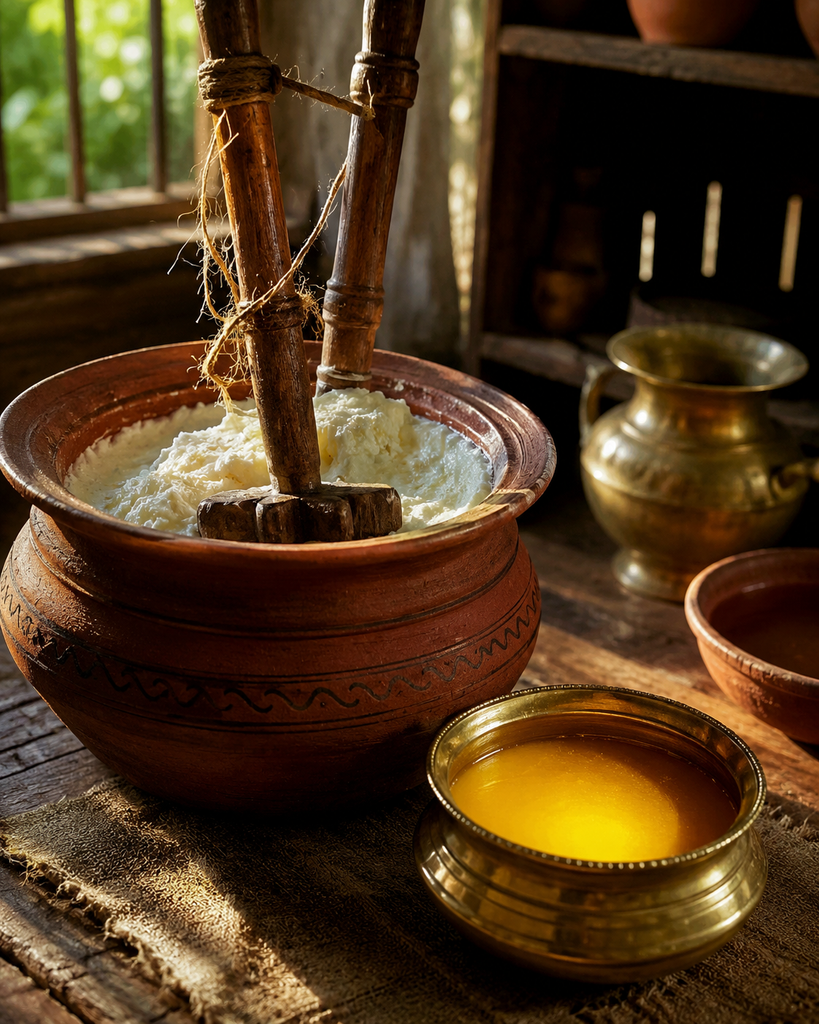
The Bilona method is a traditional preparation approach that takes an additional route between milk and finished ghee. Instead of directly processing cream into butter, the process traditionally involves curd and churning.
Fresh milk is first converted into curd through fermentation. This is an important part of the traditional process because the curd becomes the starting point for churning.
The curd is churned to separate butter from the liquid portion. Traditional churning is the defining feature that gives the Bilona method its name.
The separated butter is slowly heated. Water evaporates while the milk solids separate from the fat, leaving clarified ghee that can then be filtered and stored.
When buying Bilona ghee, don’t rely only on the word “Bilona” printed on the front of the container. A transparent producer should be able to explain how the product is actually made.
Ghee is concentrated milk fat and can be useful as part of a balanced diet. However, claims surrounding A2 cow ghee benefits should be considered carefully because traditional use and scientific evidence are not always the same thing.
Ghee is great for tempering, roasting, sautéing and enriching everyday meals. It is a popular ingredient in many Indian dishes as it has a familiar aroma.
Like other forms of ghee, A2 cow ghee provides dietary fat and is energy-dense. For that reason, portion size still matters even when the product is traditionally prepared.
Many households choose ghee because of its culinary role and traditional place in Indian food culture. That is different from claiming that it can prevent or treat a particular illness.
The possible properties of ghee have been studied but there is little evidence for any particular therapeutic benefit. So it’s better to view ghee as food, not a replacement for medical treatment.
Choosing between different jars becomes easier when you know which details deserve attention. Don’t judge a product by its packaging or price – seek for information that will help you understand its source, preparation and quality.
When a product is marketed as A2 or desi cow ghee, check for transparent details of the milk source and the reason for the claim.
If you are looking for Bilona ghee specifically, look for whether the manufacturer details the stages of curd-churning and butter-clarification rather than just using “Bilona” as a marketing term.
Look for the manufacturer name, ingredients, batch information, manufacturing details, best-before date, and applicable food-safety information.
Golden colour, aroma, or grainy texture may be noticeable characteristics, but none of these alone can prove that ghee is pure or confirm an A2 claim.
Increased price does not equal increased quality. If you are comparing products such as pure cow ghee, look at where the product comes from, how it is produced, its quality controls, packaging and how transparent the producer is.
The easiest way to understand the difference is to separate the milk source from the finished product. A2 describes a particular beta-casein profile in milk, while regular ghee is generally discussed in terms of its milk-fat composition and production.
Therefore, you shouldn’t just take it for granted that the word A2 means “healthier,” and you shouldn’t just take it for granted that Bilona is proof of its nutritional superiority. The source and the method of preparation are worth examining separately.
A simple checklist can prevent you from making a decision based purely on attractive packaging.
For example, the same checklist can be used while considering a product like Aarogyadairyfarm’s Bilona cow ghee. The point is not to buy or not buy a product based on marketing language, but to know what you are actually buying.
Not necessarily. Bilona describes a traditional production method, but “better” depends on what a buyer values.
Some people may prefer the traditional process, while others may focus more heavily on sourcing, testing, price, convenience, or taste. A sensible comparison considers the complete product rather than treating one label as a guarantee of superior quality.
Choosing ghee doesn’t have to be a war between brands. Know how Bilona ghee is made you’re buying, check the product information thoroughly, and keep health claims in context. Readers can also compare traditional ghee products with the Bilona cow ghee of Aarogya Dairy Farm. When you know what you are looking at, comparing different ghee products becomes much easier and more meaningful.
A2 refers to the beta-casein profile of the milk used as the source. It describes the milk rather than the particular method used to prepare the ghee.
The traditional Bilona process involves formation of curd and churning of milk after which the separated butter is slowly clarified into ghee. This differs from methods which begin with directly separated cream.
Ghee can be part of a balanced diet and provides dietary fat, but specific therapeutic claims should be treated carefully. A2 labeling alone does not establish that a product can prevent or treat a disease.
Not reliably. Color, aroma and texture can naturally vary so should not be used alone to confirm purity or an A2 claim.
Check the origin of the milk, the manufacturing process, the list of ingredients, the producer information, the batch description, dates (production and expiry), the packaging and if the labels are honest and do not mislead you.